
Subscriber Benefit
As a subscriber you can listen to articles at work, in the car, or while you work out. Subscribe NowA bill to close what the author said are “loopholes” in Indiana’s employment eligibility verification law could bar employers who purposefully flout the requirements from taking part in public works projects for a year.
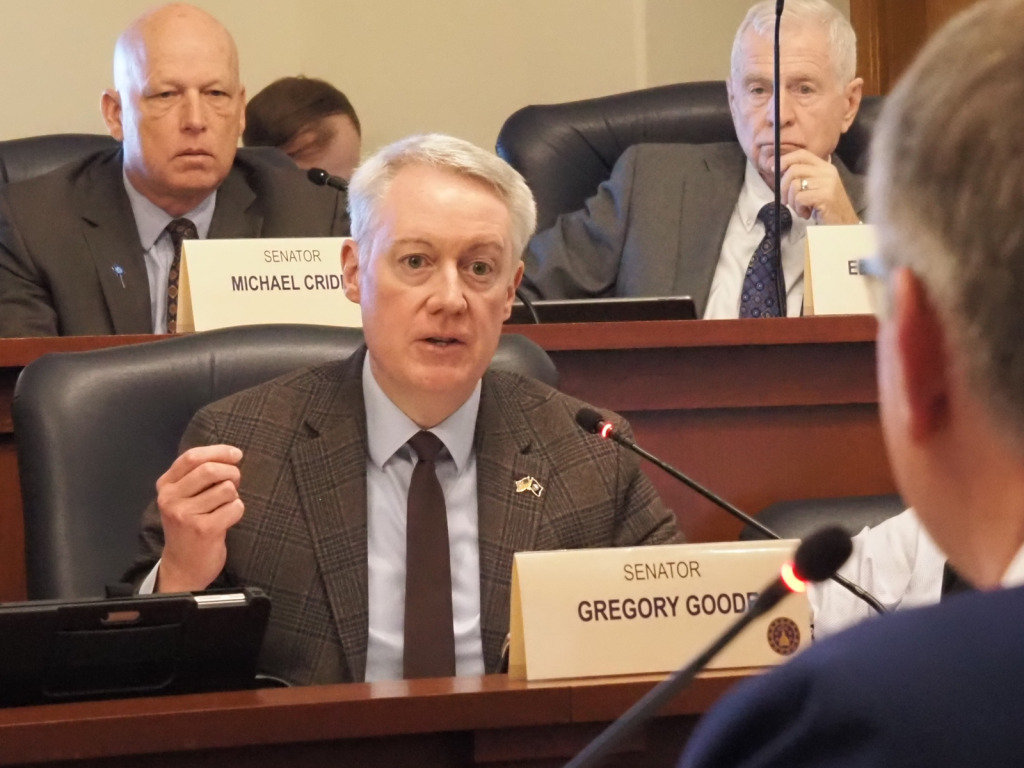
“The law of the state of Indiana currently allows for individuals who are in the United States of America illegally to work on taxpayer-funded projects,” Sen. Greg Goode told the Senate’s Pensions and Labor Committee on Wednesday. “Let that sink in for a moment.”
He said Indiana Code hasn’t “caught up with” construction delivery methods, “creating some loopholes” that he claimed divert jobs away from citizens or those on the path to citizenship.
Goode, R-Terre Haute, wants to tighten state requirements through his Senate Bill 87.
Public work project contracts entered into or renewed after June 30 would have to include a provision requiring the primary contractor and all tiers of subcontractors to enroll in E-Verify, an internet-based federal program that cross-checks a new hire’s eligibility to work in the U.S.
The system compares information from the mandatory employment eligibility Form I-9 to records maintained by the U.S. Department of Homeland Security and the Social Security Administration.
Contractors and all tiers of subcontractors would have to submit an employee’s E-Verify case number to the agency overseeing a public works project before that person could begin work.
Under the legislation, employers that “knowingly or intentionally” fail to comply would be banned from public works contracts for a year.
“I had an instance in my own district—that’s how this whole issue came to my attention—where there was a public works project that hired individuals … here illegally,” Goode told the committee. “And I stopped to think, you know, these are jobs that could have gone to people from Terre Haute or Brazil or Sullivan … I think that’s fundamentally wrong.”
Rob Henderson, the executive director of the Indiana State Building and Construction Trades Council, said the largest loophole “basically allows a construction manager on the project to self-perform” employment verification.
He said that provision applied only to state educational institutions at first, but was expanded and now is an option for “any” public works project.
Matt Bell, a lobbyist with the Associated Builders and Contractors of Indiana/Kentucky, acknowledged that’s a “glaring loophole” but said the legislation goes worrisomely further.
The group was most concerned the bill would make general contractors liable for what subcontractors—or the subcontractors of their subcontractors—do or don’t do.
“That’s a significant change in law, one that we’re very concerned about as we go forward,” Bell said.
He also characterized E-Verify as error-prone and argued the legislation wouldn’t protect employers from false negatives or positives despite the severe punishment prescribed.
“Employers acting in good faith should not be penalized,” Bell said. “I see no safe harbor in here.”
Indiana Department of Administration Commissioner Brandon Clifton threw his support behind the bill, noting it builds on an executive order from Gov. Mike Braun directing IDOA to update the state’s boilerplate contracting language with an E-Verify precondition.
“The one addition to the executive order presented in Senate Bill 87 is the verification,” Clifton said. “We are not currently verifying the use of E-Verify in our contracts. The contract itself is a self-attestation.”
But, he added, the fiscal impact remains unclear. An analysis by the nonpartisan Legislative Services Agency predicted the changes could be absorbed without additional spending.
“Are we going to verify every staff member, every employee of the contractor or subcontractor? Are we going to audit a few of those?” Clifton said. The first approach would cost more.
The legislation was eligible for testimony only on Wednesday, not a vote, with changes possible next week.
“I think there were some very important questions relating to the enforcement piece, and I really want to make sure that we’re projecting fairness,” Goode told the Capital Chronicle. “Yes, we are articulating our standards of accountability, but I think that there’s a way to do this, to work with our contractors and subcontractors, to make certain that we don’t have to be overly heavy-handed.”
Goode said he’s still hoping to get it across the finish line despite a shorter-than-usual legislative session. The idea is already further along than last year, he noted, when it didn’t get a hearing.
Lawmakers have less than eight weeks to wrap up business. The General Assembly can meet until mid-March during a non-budget year, but leaders plan to adjourn two weeks sooner to offset the cost of the two weeks they spent on an unsuccessful congressional redistricting push in December.
Indiana Capital Chronicle is part of States Newsroom, a nonprofit news network supported by grants and a coalition of donors as a 501c(3) public charity. Indiana Capital Chronicle maintains editorial independence. Contact Editor Niki Kelly for questions: [email protected].
Please enable JavaScript to view this content.