
Subscriber Benefit
As a subscriber you can listen to articles at work, in the car, or while you work out. Subscribe Now
Legislation requiring paid political influencers to report to Indiana lobbying regulators heads to the Senate floor after a Monday committee vote, despite major concerns from regulators and First Amendment advocates—and the author’s admission the bill was drafted in a rush.
A ban on ranked choice voting also advanced.
Indiana already governs professional lobbyists paid to influence the legislative and executive branches, but Sen. Scott Alexander sees a gap.
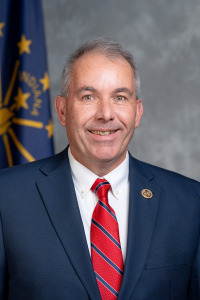
“It’s really the influencers that we’ve been seeing that are influencing politics outside of the parameters of, for instance, the lobbyists,” he told the Capital Chronicle on Monday, after his Senate Bill 267 squeaked through the Senate’s Elections Committee.
Alexander, R-Muncie, wants transparency for those “paid to influence (or) paid to protest.”
His legislation focuses on “influence campaigns,” defined as attempts to mobilize the public to take some action or contact state officials—including via protest.
Executive branch leaders like the governor, lieutenant governor, secretary of state, comptroller, treasurer and attorney general count, and so would the legislative branch’s lawmakers. Also accounted for are candidates, employees, consultants and close relatives of both branches.
Someone who encourages another person to engage in an influence campaign—and pays that person at least $500 in a year—would be required to file with the Indiana Lobby Registration Commission within 24 hours of handing over the cash, beginning July 1.
They’d need to submit detailed information on themselves, their organization, others involved in the influence campaign, their goals and their expenditures, according to the proposal.
“We would like to support Senate Bill 267, because there is certainly a need for more transparency around money spent to influence the legislative process,” said Julia Vaughn, with elections watchdog Common Cause Indiana.
However, she said, the group is opposed “because we think it’s duplicative of current law for registered lobbyists, at least, and unworkable for those it would apply to.”
Vaughn observed, for example, that the giver of money would be responsible for disclosing how it was spent, although that duty is typically placed on the recipient.
Administrative, 1A concerns
Regulator testimony revealed deeper dilemmas.
The Lobby Registration Commission is one of just two legislative branch agencies, alongside the Legislative Services Agency, said Edward Ferguson, the entity’s executive director and general counsel.
“We question the wisdom of putting the ILRC in a position of having to deal with actions taken to influence executive branch members, especially since the executive branch has its own statute concerning lobbying,” Ferguson said, noting he’d been in touch with ILRC’s commissioners about the bill.
Lobbyists who earn at least $500 annually to influence the legislative branch file with the commission. Those who make at least $1,000 annually to influence the executive branch register with the Indiana Department of Administration.
“The ILRC has never in its history regulated lobbying and influencing in the executive branch,” Ferguson told the committee. “I see a separation of powers issue here.”
Furthermore, the 24-hour deadline for reports “seems unreasonable and a bit confusing,” he added, because payments for lobbying services are often made weeks or months after.
He anticipated the ILRC would be “swamped” with reporting problems.
The agency has just one full-time employee—Ferguson—and a part-time employee, supplemented by an additional staffer during peak registration and activity reporting periods, he said.
“Our current staffing level is ultimately insufficient” to handle Senate Bill 267, Ferguson continued, in contrast to an LSA fiscal impact analysis that said increases in workload “are within the routine administrative function” of the agency and could be absorbed with “existing resource and funding levels.”
First Amendment advocates, meanwhile, warned the legislation could infringe upon constitutionally protected paid advocacy.
Samantha Bresnahan, with the American Civil Liberties Union of Indiana, said while the group supports transparency in government, “it must be balanced against constitutional rights.” The bill could “chill” political association and participation, she said.
“If what the bill’s authors hope to accomplish is to squelch paid protesters … this bill is not a way to accomplish that,” agreed Barbara Tully, with the League of Women Voters of Indiana.
Paid protester perceptions
Outrage over allegedly compensated paid advocacy is growing nationwide, although fact-checkers like Politifact have repeatedly found such accusations aren’t supported by evidence.
“I know that some of my colleagues thought there were some paid protesters during the redistricting fight,” said Sen. J.D. Ford, D-Indianapolis. Several demonstrations, both for and against President Donald Trump’s map-drawing push, were held before the campaign failed.
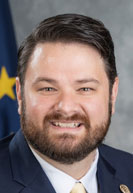
“Do you believe that … there are people that are being paid to protest?” Ford asked Alexander.
“Around the Statehouse? I would say there probably are,” he responded. “Yeah, yeah, for sure.”
Asked if his bill was aimed at paid protesters, Alexander told the Capital Chronicle, “No, not necessarily.” He acknowledged it could “catch” compensated advocates.
But, he emphasized, there’s “definitely not an intent to push down on free speech.”
Another colleague questioned whether social media influencers who are paid by political parties or outside groups would also have to report activity.
Lawmakers of both parties expressed misgivings following testimony, prompting Alexander to admit, “This is a bill that we got down to the wire on.”
Sen. Linda Rogers, R-Granger, asked if the bill could be held, but committee chair Sen. Mike Gaskill, R-Pendleton, noted the panel meets on Mondays and next Monday is a holiday. The deadline for bills to pass from committee is Jan. 26.
Legislative leaders plan to adjourn in late February, two weeks sooner than usual, to offset the cost of the two weeks they dedicated to redistricting in December—compressing the 10-week session into just eight.
“What I would like to ask the committee is that we go ahead and move the bill, if you think you can move it today with the promise from Sen. Alexander that he will work with us on a substantial revision on second reading,” Gaskill said. “I think that’s the only possibility at this time to give the bill the hope of moving forward.”
Several witnesses and committee members offered their assistance.
“I do think that it has potential,” said Sen. Stacey Donato, R-Logansport. “But, again, I offer the help to get it in a good spot, because right now it’s not.”
The legislation advanced on a 6-3 vote. Sen. Greg Walker, R-Columbus, joined two Democrats in opposition.
Ranked choice preemption moves
A prohibition on ranked choice voting was also voted out of committee.
Most elections use a single choice model. In a ranked choice version, voters rank the candidates in order of preference. If no candidate wins a majority of ballots on which they are listed as the top choice, the other rankings are used to determine a winner.
“Part of the problem with ranked choice voting,” said Sen. Blake Doriot, R-Goshen, is voters who only wish to support one candidate either complete the ballot to “vot(e) against that person at some point”—or skip the rankings and don’t get counted in later rounds.

“That scares us,” Doriot said, noting that Indiana Code is silent on the issue, and could be impacted by the results of a federal lawsuit, for example.
Opponents of his Senate Bill 12 indicated the ranked choice approach could help bridge the partisan divide.
Tully said the league in Indiana supports ranked choice voting to “reduce the toxicity of negative campaigning, to advance those candidates who have broad support, to keep candidates and campaigns issues-focused.”
Advocates of the ban, including the Indiana Secretary of State’s Office, said ranked choice voting is complicated to administer and creates longer ballots for weary voters to fill out.
Jason Snead of the Honest Elections Project said Indiana should outlaw the system even though it’s not currently used, adding, “You should not wait for the ranked choice voting lobby to make Indiana a target.”
Brad King, the Republican co-director of the bipartisan Indiana Election Division, said the state’s home rule law already bars local units of government from using election procedures like ranked choice voting, but that it doesn’t prevent all litigation.
The legislation advanced on a 7-2 vote, along party lines.
The Indiana Capital Chronicle is an independent, nonprofit news organization that covers state government, policy and elections.
Please enable JavaScript to view this content.