
Subscriber Benefit
As a subscriber you can listen to articles at work, in the car, or while you work out. Subscribe NowAddiction treatment centers in Greenfield and Knox are at the heart of a lawsuit that seeks to replace the centers’ Indianapolis-based operator, Crossroads Health Management LLC, over allegations of financial mismanagement and diversion of the facilities’ revenue.
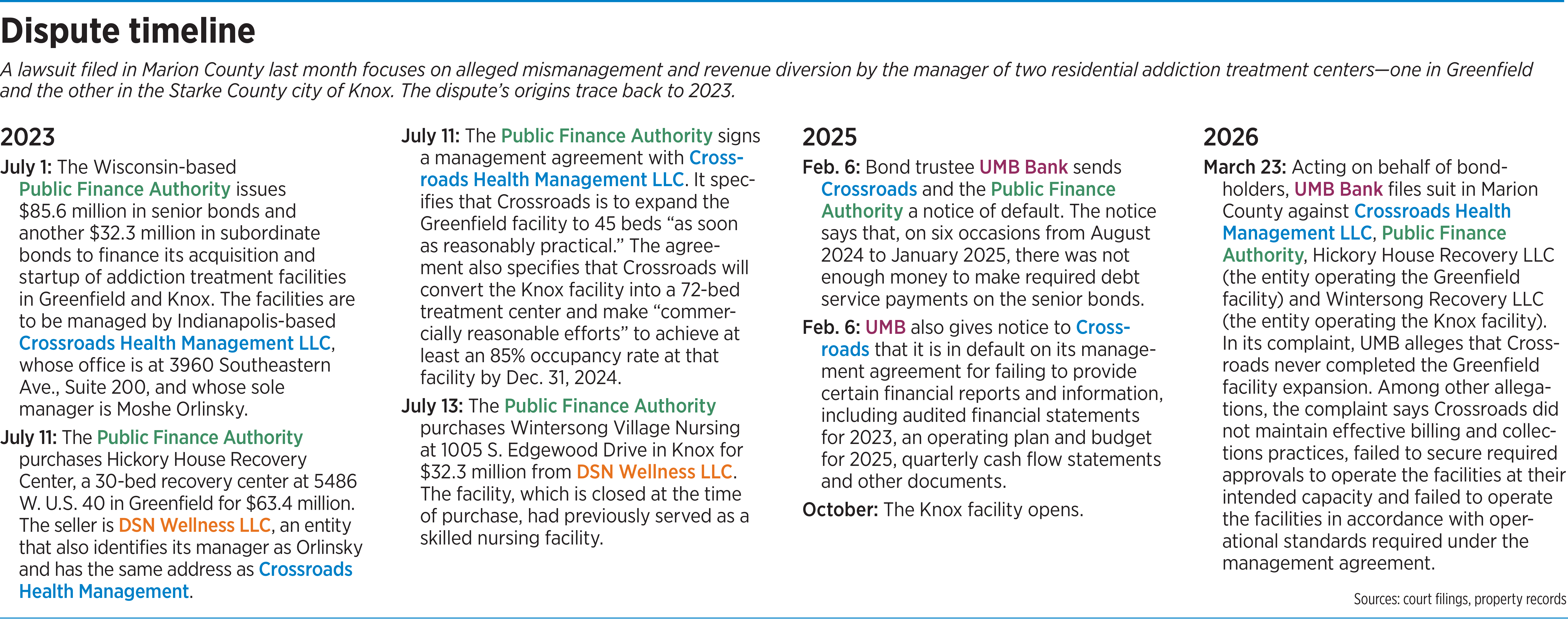
The Wisconsin-based Public Finance Authority purchased the two facilities in 2023, issuing $117.9 million in bonds to finance the acquisition and startup costs and hiring Crossroads to manage both facilities. Under terms of the management agreement, the facilities serve as collateral for the bonds, generating the revenue to repay the bondholders.
Now Kansas City, Missouri-based UMB Bank, the trustee representing the bondholders, is suing both Crossroads and the Public Finance Authority over what UMB characterizes as Crossroads’ failure to live up to the terms of those agreements, leading to a “collapse” of the project.
The UMB complaint alleges that the Greenfield and Knox treatment centers have fallen so short of revenue projections, both continuity of patient care and bondholders’ investments are at risk unless the court appoints a receiver to take over operations.
Crossroads denied the allegations in a statement and said, “We intend to defend ourselves vigorously.”
UMB filed the lawsuit March 23 in Marion County. In addition to Crossroads and the Public Finance Authority, or PFA, the two other named defendants are Hickory House Recovery LLC and Wintersong Recovery LLC, which does business as Hickory Treatment Center at Knox. Those defendants are the entities that handle day-to-day operations at the Greenfield and Knox facilities, respectively.
Moshe Orlinsky is identified in various bond agreements as the manager of Crossroads and identified in the complaint as the sole member of the LLC. The complaint identifies Hickory House Recovery and Wintersong Recovery as also being affiliated with Orlinsky. (The documents do not specify where Orlinsky lives.)
The court docket does not yet contain information about who is representing Crossroads, Hickory House Recovery or Wintersong Recovery in the case.
Defendants’ responses
IBJ sent an email to Orlinsky seeking comment. A public relations firm responded on Orlinsky’s and Crossroads’ behalf with the following statement, attributable to a Crossroads spokesperson:
“We are aware of the lawsuit and believe its claims are entirely without merit. Crossroads Health has always put the wellbeing of our patients first, and that commitment has guided every decision we have made in operating these facilities. We have a long track record of success at our centers and have worked tirelessly through the complexities of expanding our footprint,” the statement said.

“The events described in the complaint reflect inherent operational and development realities — not any misconduct by our organization,” the statement continued. “We intend to defend ourselves vigorously against these allegations and are confident the legal process will demonstrate that our conduct was appropriate throughout.”
The PFA’s attorney said the organization shares UMB’s goal of protecting the bondholders.
“Even though PFA is a defendant and the trustee is the plaintiff, it is a situation where PFA is cooperating with the trustee to get the receiver installed, to turn the project around, to remove the manager that we think is doing some things the manager ought not be doing and not doing things we think the manager ought to be doing,” said attorney Andy Phillips.
The situation is unusual for several reasons.
Story Continues Below
The PFA is what’s known as a conduit bond issuer — an entity authorized to issue municipal bonds that finance projects such as charter schools, health care facilities and assisted-living facilities. Unlike most conduit issuers, though, the PFA — as authorized by Wisconsin state law — can issue bonds for projects in all 50 states.
“We are one of just a handful of nationwide conduit bond issuers,” Phillips said.
What makes this particular project uncommon is that the PFA actually owns the two treatment facilities. Typically, Phillips said, the PFA issues bonds and provides their proceeds to the entity developing the project.
Because Crossroads is a for-profit entity, the PFA issued the bonds under a program in which it owns the facilities and hires an outside party — in this case, Crossroads — to manage them.
Phillips said the PFA uses this arrangement when a project offers a public benefit but otherwise would not qualify for tax-exempt bond funding. The PFA has used the arrangement, which it calls its Asset Ownership Program, only about 10 times since the organization was formed in 2010, he said.
For the Crossroads project, an Indianapolis entity called DSN Wellness LLC sold the Greenfield and Knox facilities to the PFA. The official sales disclosure forms for both transactions identify Orlinsky as DSN’s manager. The forms also list DSN as having the same address as Crossroads.
Financial details
On July 1, 2023, the PFA issued $85.6 million in senior bonds and $32.3 million in subordinate bonds to finance acquisition and startup costs for the two facilities. As the terms imply, senior bonds are prioritized above subordinate bonds for repayment in the event that a project goes into default.
Then, on July 11 and July 13, respectively, the PFA paid DSN $63.4 million for the Greenfield property and $32.3 million for the Knox facility.
As a conduit issuer, the PFA bears no financial responsibility for repaying the bonds.
Under the management agreement between Crossroads and the PFA, Crossroads is required to deposit revenue from the Greenfield and Knox facilities’ operations into a fund from which bond payments are made.
Under two separate liquidity-support agreements, Crossroads also agreed to provide up to $6 million via letters of credit that could be drawn upon to cover any shortfalls.
According to the first-year operating plan and budget submitted as part of the management agreement, the Greenfield facility was expected to generate profits of $5.25 million for the 12-month period from August 2023 to July 2024. That projection was based on the expectation that Crossroads would expand the facility from 30 beds to 45, thus increasing the amount of revenue it would generate from providing residential care.
The Knox location, which was not in operation when the PFA bought it, is a 72-bed site that previously operated as a skilled-nursing facility.
The first-year budget and operating plan called for Crossroads to convert the Knox site into a treatment center that would open in May 2024, generating $1.11 million in profits.
 The allegations
Crossroads failed to live up to its end of the deal, UMB alleges, and as a result the revenue from the facilities fell far short of those projections.
The lawsuit alleges that the Knox facility didn’t open until October 2025 and that the Greenfield expansion was never completed. Therefore, the facilities did not generate sufficient revenue to cover bond payments, the lawsuit alleges.
UMB also alleges that Crossroads fell short in the facilities’ financial management.
As examples, the lawsuit alleges that Crossroads did not deposit facility revenue into trustee-controlled accounts as required by the management agreement, that Crossroads deliberately delayed opening the Knox facility to gain leverage in negotiations with the trustee and that it stopped providing financial information to UMB after UMB drew on Crossroads’ letters of credit to make up for financial shortfalls.
In another accusation of financial mismanagement, the lawsuit alleges that Crossroads did not bill patients for services in a timely manner.
By late 2024, Crossroads reported that “receivables totaled approximately $2.7 million — roughly half of annual income — while cash balances remained low and the required revenue transfers to the Trustee to pay debt service were not being made,” the lawsuit alleges.
In December 2024, the lawsuit alleges, Orlinsky told UMB that Crossroads was deliberately delaying its billing, sometimes for up to six months, so patients would run through their insurance deductibles before the facilities submitted claims. By doing this, the facilities could bill insurers directly rather than pursuing payment from patients. Once the facilities billed the insurers, those claims would be paid quickly and the project would become “‘flush with cash,’” the lawsuit alleges that Orlinsky said.
But things didn’t happen that way, the lawsuit alleges, and by late last year, the facilities’ accounts receivable — the amount in outstanding payments for services rendered to patients — exceeded $6 million. Nearly $5 million of that was at least 180 days old.
As of the date the lawsuit was filed, UMB alleges, the Knox facility had not yet generated any cash receipts.
UMB said in its complaint that it hired a forensic accounting firm because it was concerned that revenue was being mismanaged or diverted.
“When [UMB] requested documentation necessary to complete that review, focusing specifically on confirming the reported outstanding receivables and on a number of suspicious transfers, [Crossroads] refused to provide it,” the complaint alleges.
Outsiders’ perspectives
Health care consultants who are not involved with the lawsuit — and who were not commenting on this lawsuit in particular — said they frown on the practice of delayed billing.
“That’s a horrible approach,” said Brad Greenstein, CEO of Woodlake, New York-based Arrow Consulting.
Greenstein’s area of expertise is in advising operators who are opening behavioral health facilities, including those focused on drug and alcohol treatment and those focused on mental health.

Offering a hypothetical example, Greenstein described a situation in which a patient has insurance with a $10,000 deductible. Until that deductible is met, the patient is responsible for paying for treatment. The provider might not get that payment promptly — or ever — if the patient can’t pay the bill.
“A lot of patients don’t have that kind of money,” Greenstein said.
But once the deductible is met, the provider can directly bill the insurer. The patient is still responsible for the first $10,000, but the insurer is obligated to pay claims after that point — even if the patient never pays the portion he or she owes, Greenstein said.
Ryan Rohd, CEO of Chicago-based C4 Consulting, estimated that 15% to 25% of providers practice delayed billing, but he said he considers the practice “a little unethical.”
“Ideally, you treat the person that you need to treat. … You bill them, you bill them timely, and the patient is responsible for their deductible no matter what services they’re receiving,” Rohd said.
In its complaint, UMB is asking the court for damages in unspecified amounts and to appoint a receiver with authority over both treatment facilities and their revenue, bank accounts, financial records and, to the extent necessary, Crossroads and the operating companies that run the facilities.
Looking ahead, PFA attorney Phillips expressed both frustration with how things have developed and hope for a positive outcome.
“This project — it was such, in our mind, a good public benefit project. I know our board was excited about this project because of the increased need for these addiction treatment centers,” Phillips said. “And so to see it end up where it is today — hopefully, we can turn it around, but to see where it is today is awfully disappointing.”•
Please enable JavaScript to view this content.