
Subscriber Benefit
As a subscriber you can listen to articles at work, in the car, or while you work out. Subscribe Now
It’s been almost five years since the city of Indianapolis joined sustainability-minded municipalities in passing an ordinance that requires the owners of large buildings to report their annual utility use.
Today, most building owners aren’t complying. The city also faces an increasing number of challenges to enforcing the policy, the goal of which is to reduce emissions from the built environment.
The program, called “Thriving Buildings,” is managed by the city’s Office of Sustainability and has a phased-in implementation schedule. It requires owners of large buildings to annually collect and submit data about water, electricity, natural gas, steam or other energy use for entire buildings. The city started with its own large buildings a few years ago.
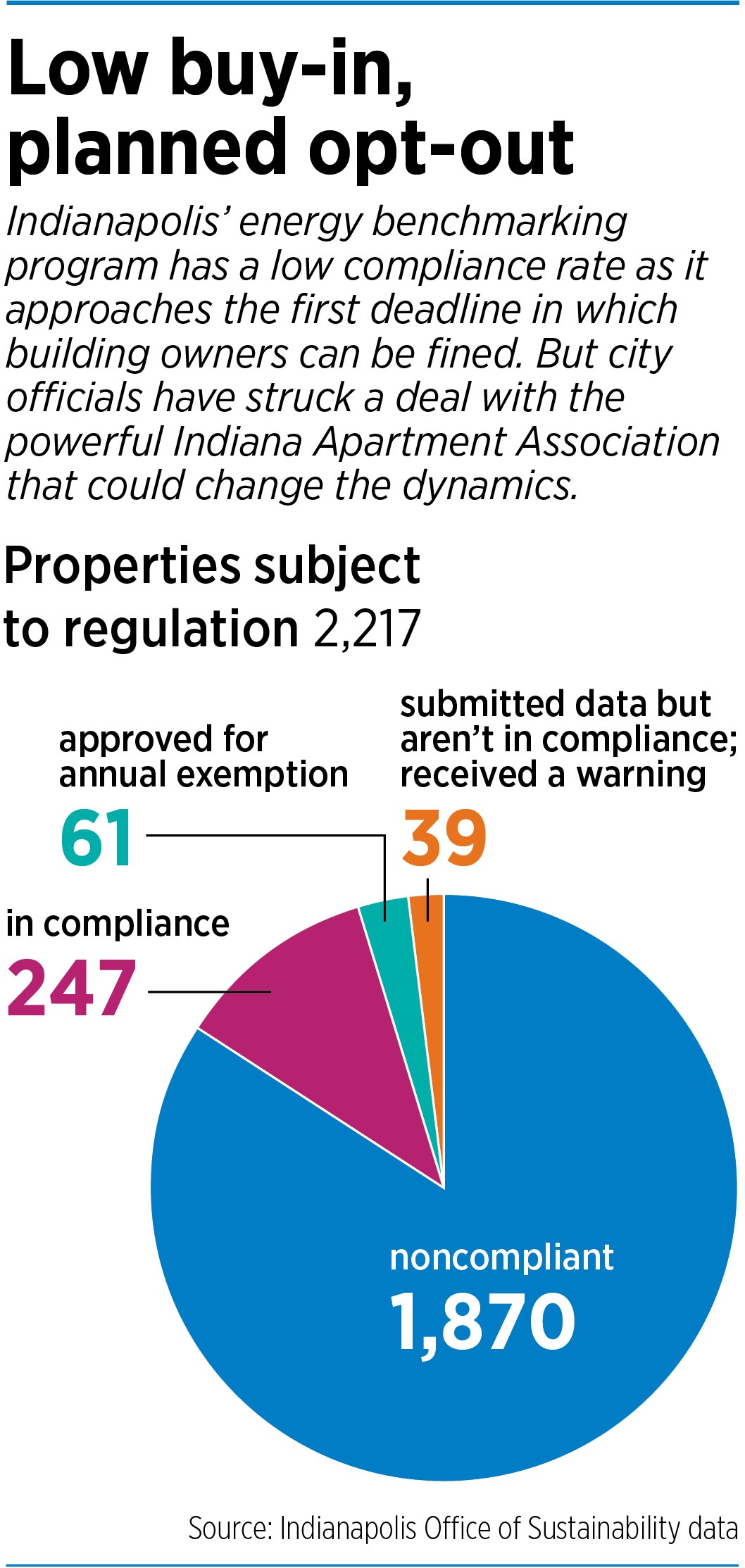
Last year, the city required that managers of buildings greater than 50,000 square feet submit utility data for the prior year. To date, the city has collected information for only about 13% of the 2,217 buildings that fall in that category.
And apartment buildings, which previously could opt out of the program, are now automatically exempted.
 Also, a House bill that moved out of committee this week in the General Assembly would require benchmarking participation to be voluntary. An attempt last year by state lawmakers to prohibit benchmarking programs failed.
The automatic exemption for apartments is one of several challenges the city has already faced in implementing the program, which is scheduled to begin assessing small fines this year to building owners that don’t comply.
Other challenges, according to Michael Milner, the program’s administrator, include:
◗ A lack of direct connection to utility data. Cities with high compliance have utility companies that aggregate the data and must share that information with the city. Some municipalities even own the utilities.
◗ Difficulty obtaining solid contact information for building managers, further hampered by city staff turnover. Milner is the third person to hold the administrative role since the ordinance passed in 2021, which left building managers without a consistent point of contact.
◗ The number of buildings Indianapolis aims to obtain data from, which is larger than some successful cities—Milner said some benchmark just 200 or 300 buildings.
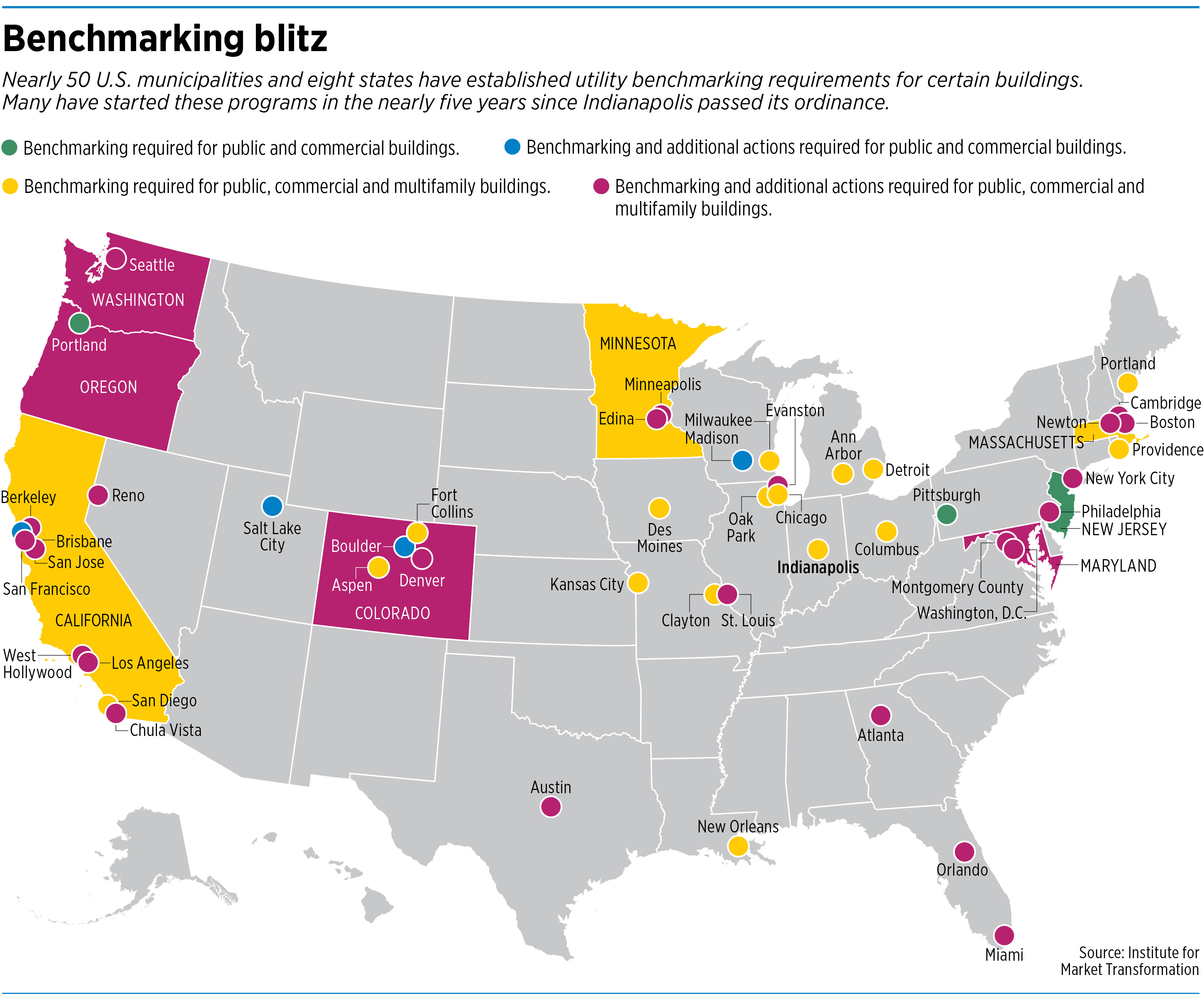
Nearly 50 U.S. municipalities and eight states have established utility benchmarking requirements for certain buildings. Milner described Seattle as being “the golden city” for benchmarking. There, city leaders say they reached 96% compliance in 2024, having collected data for more than 3,000 buildings.
But Seattle’s ordinance, passed in 2016, has had nearly a decade of practice; Indianapolis’ is still in its formative stages, he said.
Before the city starts assessing fines this year, Milner is prioritizing increased program participation. He hopes to see the compliance rate rise exponentially this year as he implements a schedule of times he’ll be available to answer questions or troubleshoot problems, and as he continues to try to contact building managers, so far mostly through cold calling.
The fines that 2026 will bring are measly: just $100 for the first year of noncompliance and $250 for subsequent years. But program leaders say the goal isn’t to rack up fines; it’s to get the business community on board.
“We’re really trying to just make buildings as efficient as possible, lower utility rates for people, because we all know that that’s an issue,” Milner told IBJ.
A 2020 Greenlinks Analytics report estimated that Indianapolis property owners could, over 10 years, cut 9,000 tons of carbon emissions and 75 billion gallons of water usage—all while saving $194 million in utility costs just through a benchmarking program.
A major opt-out
While Indianapolis is working to educate building managers about the program and persuade them to submit data, one major subset of owners has a new blanket exemption: apartments.
Owners of buildings that are at least half residential and have more than four meters were already eligible to request an exemption from the ordinance’s reporting requirement.

Mo McReynolds, the Office of Sustainability director, said that unlike some cities that have implemented similar benchmarking programs, utility companies serving Indianapolis don’t aggregate data usage for buildings with multiple meters, like apartment buildings. That creates what can be a time- and cost-prohibitive process for those managers and owners, she said. That was the reason behind the exemption eligibility.
But apartment owners weren’t happy about having to request the exemption. A legislative proposal last year threatened to kill the benchmarking program altogether—in part at apartment owners’ urging—but was ultimately axed.
Still, the Office of Sustainability met with the Indiana Apartment Association, a powerful lobbying group that previously succeeded in exempting its members from a downtown improvement fee, to work out an agreement. All 400 buildings managed by IAA members were automatically exempted from the benchmarking program as of Jan. 9.

And on Monday, Rep. Jim Pressel, R-Rolling Prarie, introduced language in a bill that would make the entire benchmarking program unenforceable.
Pressel amended House Bill 1150, which prohibits governing entities like homeowners associations from regulating fuel sources for motor vehicles and equipment, to also prohibit counties and municipalities from adopting or enforcing a utility usage data ordinance. The House Roads and Transportation Committee passed the amended bill Monday, and it now moves to the full House for consideration.
Pressel said his amendment wouldn’t nullify the Thriving Buildings ordinance altogether and that the city could continue operating it on a voluntary basis.
Despite the deal that had already exempted apartment owners, Indiana Apartment Association CEO Brian Spaulding spoke favorably of the amendment during the committee hearing. Spaulding cited the difficulty of obtaining utility use data for apartment buildings but noted “ongoing conversations” with the Office of Sustainability.
McReynolds testified before the committee that the program is “more carrot than stick,” in that no one has been fined yet, and the city is making the argument that building owners should comply for the potential savings. Through that means, the city has gotten to the current, albeit low, compliance level.
She said she hopes the city doesn’t have to issue a single fine for noncompliance. Instead, she said, the department aims to improve its contact information for owners over the next six months to make all building managers that could be fined aware of the program.
By exempting apartments, the city expects compliance numbers to artificially inflate. To combat that, McReynolds said, the office will likely present two versions of compliance: one that shows exemptions and one that shows participation.
“Participation is really the number we’re concerned about,” she said, adding that the overall compliance rate is less important than getting buy-in from individual companies and organizations. For example, if the office can say 500 organizations are reporting utility use at the end of the year, McReynolds would consider that a win.
Under the ordinance, the Office of Sustainability is required to set up transparency portals and anonymized scorecards that reflect both municipal and private utility use. After the June 1 deadline to submit 2025 data, Indianapolis plans to post scorecards of municipal buildings, which were the first to be benchmarked as part of the city’s goal to lead by example.
Privately owned buildings won’t have scorecards until the end of the 2026 compliance season, which isn’t until summer 2027. With apartments exempted, Milner and McReynolds say that retail, office and tenant-owned buildings will make up the bulk of those required to report.
Managers question purpose
Indianapolis has engaged with building owners and managers, including through the Building Owners and Managers Association of Indiana, since the Office of Sustainability worked with a stakeholder group in 2020 to craft the proposal. The office has also frequently hosted tutorials on using the Energy Star platform, called “data jams.”
But building managers and owners still have concerns and complaints about the way the ordinance is playing out.
Sarah Kuester, executive director for BOMA Indiana, said the organization supports “voluntary, non-public benchmarking,” but that the ordinance ultimately focused on “public dissemination, compliance steps, and noncompliance penalties.”
Additionally, Kuester said the initiative should be geared more toward incentivizing energy efficiency and arming owners and managers with non-public, project-specific information, anonymized peer group information, and access to resources and pathways to savings.
There’s a disconnect between the city—where administrators see the law as a cost-saving opportunity (they identified a broken water meter at the Indianapolis Animal Care Services facility in its own benchmarking work)—and building managers, who say they collect and analyze their utility bills without the city’s help.

Carmel-based Hokanson Cos. manages about 900 properties nationwide, with a handful in Indianapolis. Chris Horsley, president and CEO of Hokanson, said the ordinance is an unnecessary burden because property managers already aim for energy efficiency.
“It’s like being a bank and not reconciling your books. It’s what you do,” Horsley told IBJ. “If somebody doesn’t, you don’t have to have the government tell you.” It’s unclear what value the program has for taxpayers and how the city plans to use the data, he added.
So far, the Office of Sustainability hasn’t collected enough info to show the project’s overall impact on utility bills or greenhouse gas emissions. But the Institute for Market Transformation, a nonprofit think tank focused on environmental sustainability, says buildings that benchmark reduce energy use an average of 2.4% a year.
Alexandra Laney, IMT’s communications director, also pointed to the organization’s research that found New York City decreased building emissions 26% from 2010 to 2023 through benchmarking. Staff at IMT also wrote that benchmarking “lays the groundwork for broader reforms, like offering targeted incentives to improve energy efficiency, or setting building performance standards.”
Getting the word out
Before program administrator Milner’s start, the city had attempted to notify building owners and property managers about the ordinance through postcards mailed to the building addresses. That was ineffective in many cases, though, because the person who handled utility bills for the property often wasn’t on-site.
That’s why Milner said he’s focused on cold calling. Additionally, he’s swapped the postcards for a letter with city of Indianapolis letterhead to better communicate the requirement since postcards are more easily discarded.
Some building owners and managers were unaware of the ordinance, or its specifics, until they were contacted by IBJ. That’s despite the city’s outreach efforts and information shared regularly by the BOMA of Indiana.

Carmel-based REI Real Estate Services President Mike Wells told IBJ in an email that his company handles at least three downtown buildings that are required to benchmark, including the Emmis building at 40 Monument Circle and the NCAA National Office at 700 W. Washington St., but “had no idea of [the ordinance’s] existence.”
Still, Wells doesn’t object to the requirement because property managers already collect utility data to save money in energy-guzzling office buildings, and the time commitment to submit it to the city should be minimal. Although these properties currently aren’t compliant, he said he expects them to be before the city begins to issue fines.•
Please enable JavaScript to view this content.