Subscriber Benefit
As a subscriber you can listen to articles at work, in the car, or while you work out. Subscribe Now
Two Zionsville-based insurance companies face a lawsuit alleging they misled annuity customers about investment risks and how much of their money was being used to finance businesses connected to billionaire Los Angeles Dodgers owner Mark Walter.
California resident Richard Phillips filed the lawsuit Oct. 12 in federal court in Indianapolis. He says he paid $123,821 for four annuities in 2024, three from Gainbridge Life Insurance Co. and one from Clear Spring Life and Annuity Co.
The Indiana lawsuit is the latest development in a months-long controversy surrounding the insurance companies’ investments in businesses affiliated with Walter.
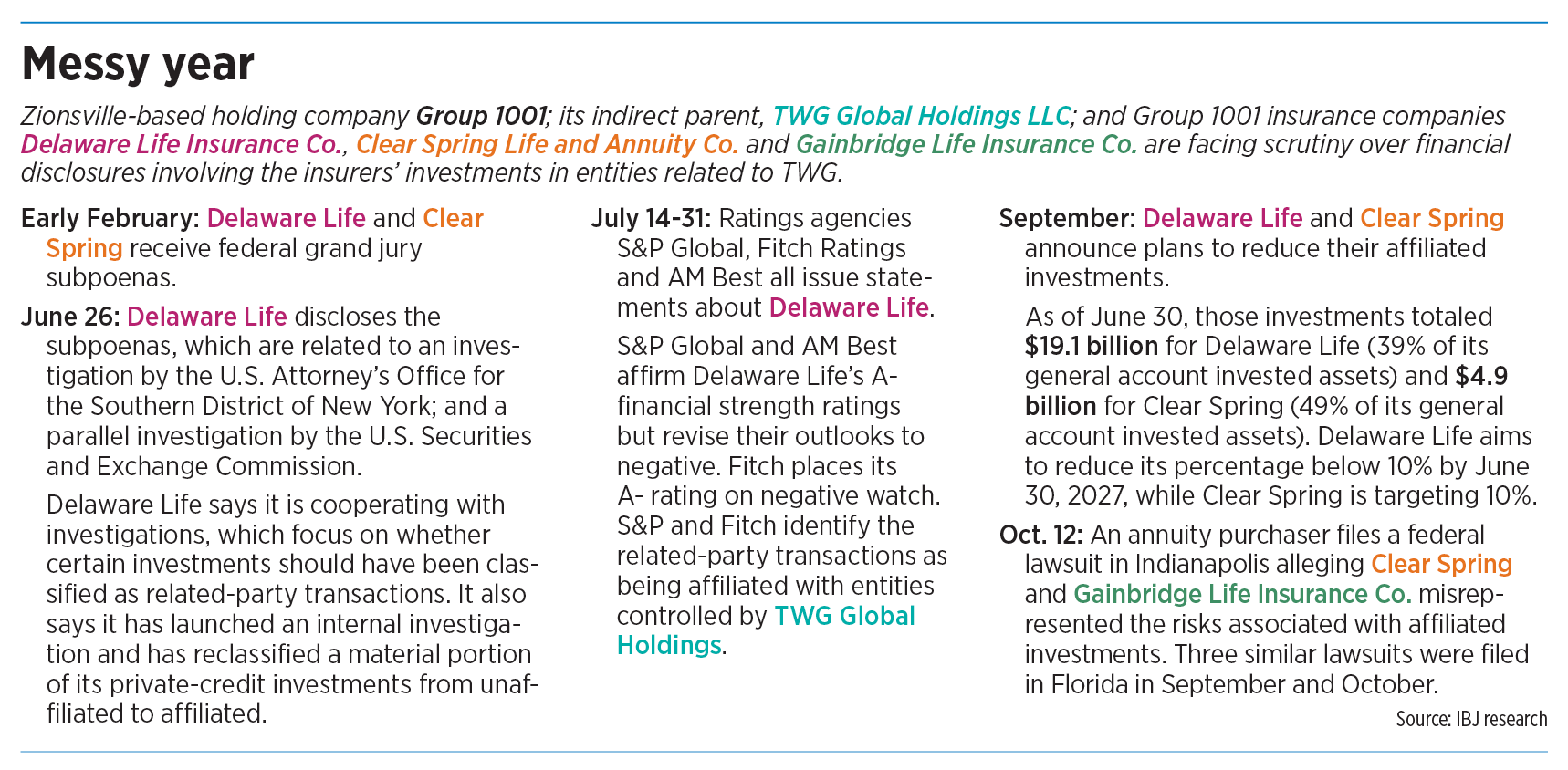
Federal authorities are investigating Clear Spring and Delaware Life Insurance Co., both owned by Zionsville-based Group 1001. Customers have filed four lawsuits, and the insurers have announced plans to reduce their investments in affiliated businesses by billions of dollars.
In his complaint, Phillips alleges that Gainbridge and Clear Spring did not put customers’ premiums into “safe, independent investments that benefit annuitants (as Clear Spring and Gainbridge marketing and brochures represented), but instead funneled them into loans and financing for companies related to or controlled by Walter.”
Those related-party investments, the lawsuit alleges, include two bonds totaling $309.8 million bond held by Clear Spring and issued by Los Angeles-based American Media Productions LLC. The lawsuit describes American Media Productions as the owner of SportsNet L.A., a regional television channel that airs Dodgers baseball games.
Group 1001 is an insurance holding company with more than 1,500 employees, including several hundred in the Indianapolis area. Its subsidiaries — including Delaware Life, Gainbridge and Clear Spring — have combined assets under management of $87.1 billion and more than 540,000 active annuity contracts and life insurance policies.
Walter controls TWG Global LLC through several holding companies, including TWG Global Holdings LLC. TWG Global LLC, in turn, indirectly owns a controlling stake in Group 1001, the parent company of Gainbridge, Clear Spring and Delaware Life.
TWG’s other holdings include the Dodgers, Indianapolis-based Andretti Global and the Cadillac Formula One team, which has operations in Indianapolis; Charlotte, North Carolina; and the United Kingdom.
Phillips is asking the court to certify the case as a class-action lawsuit, potentially allowing other Gainbridge and Clear Spring annuity holders to be included in the litigation. The court has not ruled on that request.
The proposed class would include anyone who purchased or made a payment on an annuity issued by Gainbridge, Clear Spring or Clear Spring’s predecessor, Guggenheim Life and Annuity Co., from July 1, 2016, to June 30, 2026.
“Clear Spring and Gainbridge had significant portions of their general accounts invested in riskier, related-party transactions that made the general accounts of the insurer far riskier” than what Phillips and other annuity holders had been promised and paid for, the complaint says.
The bigger picture
The Indiana lawsuit follows three similar suits filed in Florida in September and October. The litigation comes amid federal investigations into Delaware Life and Clear Spring. Delaware Life is named as a defendant in two of the three Florida cases but not in the Indiana case.
Delaware Life disclosed the investigations in June. The U.S. Attorney’s Office for the Southern District of New York and the Securities and Exchange Commission are investigating the insurers’ disclosures about investments in TWG-related entities.
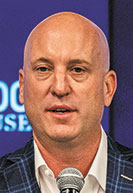
The Indiana lawsuit also names Walter and four executives whom the complaint identifies as holding positions at both insurers: CEO Daniel Towriss, Chief Financial Officer Fang Linda Wang, Chief Legal Officer Michael Bloom and Chief Accounting Officer Ellyn Nettleton.
“Group 1001 Insurance is aware of the recently filed lawsuit,” a company spokesman told IBJ via email when asked for comment on the Indiana case. “No court has ruled that Group 1001 Insurance or Delaware Life Insurance Co. did anything wrong, and we intend to defend the case vigorously, consistent with our long track record of serving policyholders with integrity.”
IBJ reached out to each of the Group 1001 executives but received no individual responses. The Group 1001 spokesman said the executives had authorized him to respond on their behalf and that each declined to comment.
IBJ also attempted to contact Walter through TWG and through Paul Wolfla, the Faegre Drinker Biddle & Reath LLP attorney who is representing him in the Indiana lawsuit, but did not receive responses.
On Aug. 26, TWG issued a statement about the investigations saying, in part, that “TWG and the Group 1001 insurance companies are working cooperatively and in partnership with the Delaware Department of Insurance to address the identified affiliated investments and ensure they are treated in accordance with applicable regulatory requirements.”
TWG also described affiliated transactions as a “commonplace” practice that are “a part of the insurance industry’s normal course of business.”
In September statements, Delaware Life and Clear Spring outlined their plans to reduce their holdings of related-party assets.
As of June 30, affiliated investments made up $19.1 billion, or 39%, of Delaware Life’s general account invested assets, and $4.9 billion, or 49%, of Clear Spring’s general account invested assets, according to the companies’ statements.
The companies said they were working with TWG to reduce those percentages to 10% for Clear Spring and below 10% for Delaware Life by June 30, 2027.
On Oct. 22, Delaware Life said it had received regulatory approval for the first of several planned asset exchanges between it and TWG Global. Under the approved exchange, Delaware Life will shift about $3.8 billion in affiliated assets to TWG and receive an equivalent amount of non-affiliated assets in return.
Risk vs. reward
Regulators have good reasons for wanting to know the extent to which insurers are investing in affiliated entities, experts say.
An annuity is an insurance product in which a customer pays a premium or series of premiums to an insurer in exchange for payments that can provide a stream of income. The insurer invests the customer premiums to help generate the returns needed to make those payments.

Regulators monitor insurers’ investments because the returns help fund annuity payments and insurance claims, said Leslie Hodder, the David Thompson chaired professor of accounting at Indiana University’s Kelley School of Business in Bloomington.
“Insurance companies have to make investments,” Hodder said. “That’s part of their business model. But they should be diversified, and those investments should be sufficiently safe” so that the insurer can meet its financial obligations to its customers.
Spencer Anderson, an assistant professor of accounting at the Kelley School in Bloomington, said related-party investments can be riskier than investments in unaffiliated parties.
He offered a hypothetical example involving an insurance company whose owner also owns a chain of pizza restaurants.
If the insurer uses customer premiums to lend money to the pizza chain, the loan terms might favor the restaurant business more than those an unrelated lender would offer, Anderson said. If the pizza chain fails, the insurer also might be less aggressive in pursuing repayment.

That’s much riskier for the annuity holder than if the insurer were to lend the money in the open market “because the normal dynamics of investment and risk and incentives are all different once I am on both sides of the equation,” Anderson said.
Those risks matter to annuity holders, he said, because customers who don’t fully understand an insurer’s investment exposure might accept lower returns than they otherwise would.
“If I know that a big slice of my insurer’s money depends on its owner’s other companies, I’d either want a higher rate for that risk, I’d want a better return on that annuity, or I’d go and buy from someone else where they’re not engaging in that kind of risk,” Anderson said.
Phillips has asked the court to let him exit his annuities without penalties or award damages to compensate him for the alleged misrepresentations.•
Please enable JavaScript to view this content.