
Subscriber Benefit
As a subscriber you can listen to articles at work, in the car, or while you work out. Subscribe Now
Corrections and clarifications: This story has been updated to correct the total project cost of $107 million.
PLAINFIELD — Dozens of recruits clad in khakis and tucked-in black polos stood toe-to-toe inside the Indiana Law Enforcement Academy gymnasium Wednesday morning, snapping to attention as instructors barked commands across the polished floor.
One young recruit from Logansport was called forward and asked to recite — “Loudly!” — why he wanted to become a police officer.
“Because I wanted to make a difference, and I wanted to mean something to my family,” he shouted. It was the cohort’s third day of an intensive 10-week training.
Watching nearby, ILEA Executive Director Tim Horty quietly nodded.
“That’s what we’re trying to drill in them,” he told the Indiana Capital Chronicle. “And with professionalism — that’s got to start with quality training.”
The scene unfolded inside a campus that barely resembles the law enforcement academy of just a few years ago.
The Plainfield facility just west of Indianapolis is nearing the finish line on a sprawling, yearslong renovation and expansion project that features college-like dorm rooms, expanded classrooms outfitted with modern technology, a newly constructed emergency vehicle operations track and a mock “scenario village” where trainees now practice responding to domestic disturbances and other real-world calls.
It’s one of Indiana’s largest recent public safety investments, transforming the state’s main police training campus into what Horty hopes will become “the envy of training facilities across the country.”
That’s in spite of delays and escalating costs — and scrutiny over the higher-than-expected price tag.
The project, first backed by lawmakers in 2021, has ultimately grown into a multimillion-dollar investment supported through a combination of state appropriations, federal pandemic relief funds and deferred maintenance dollars.
An initial $70 million was approved by the General Assembly in 2021. Another $15.6 million in federal American Rescue Plan Act money came in 2022, plus additional appropriations approved over subsequent budget cycles.
State contracts show more than $6 million paid to Indianapolis-based CSO-Architects for planning and designs, and nearly $97 million to Shiel Sexton, which has led the construction project.
For Horty, the price tag reflects what he sees as a long-overdue investment in police training.
“We reap what we sow when it comes to training,” he said during a lengthy interview and campus tour Wednesday. “We have to invest in our training in order to expect professional law enforcement officers.”
Even so, Senate Appropriations Chairman Ryan Mishler, R-Mishawaka, pressed Horty during a State Budget Committee hearing last fall over repeated and rising funding requests tied to the academy overhaul.
“Hallelujah, it’s gone way over budget,” Mishler said after listing years of appropriations “pumped into ILEA.”
Mishler questioned whether Indiana would have been better served building smaller regional training facilities around the state rather than continuing to expand the Plainfield campus.
Horty defended the academy’s residential training model, arguing that the centralized campus allows recruits from across Indiana to live and train together while helping instill discipline and professionalism.
“I think it makes them better trained. It makes them safer. It gives them a more professional outlook on their training, and frankly, it gives the communities that they go back and serve a better product,” Horty told the Capital Chronicle. “We have to get better every day. And I think this allows us a substantial step in that direction.”
A growing campus
The physical footprint of the academy has nearly doubled during the project, Horty said. Much of the focus has centered on dormitories that academy leaders said had become outdated and overcrowded.
At one point, three recruits were sharing rooms designed decades ago.
“The Department of Correction told us they couldn’t put three inmates in that same space,” Horty said.
Just two recruits bunk in each of the new living quarters.
The residential hall also includes upgraded restrooms, lounges, study areas and recreation spaces with ping pong, pool and foosball tables. Furniture for the rooms was sourced from Greenfield-based University Loft Company, while picnic tables outside some facilities were built by Indiana prison inmates for roughly $200 apiece.
“These are human beings that we’re trying to give some creature comforts to,” Horty said. “But yet, understanding that this is a disciplined environment.”
The campus now has capacity for about 400 recruits, up from roughly 300 previously.
Current academy classes range from 10-week to 16-week basic training courses. Roughly 500 to 600 students cycle through the academy annually.
When lawmakers first approved the project in 2021, officials anticipated the initial $70 million appropriation would cover much of the work.
But inflation and pandemic-era construction cost spikes complicated those plans.
“It was evident early that the $70 million wasn’t going to be enough to accomplish what we were after,” Horty said, adding that academy officials did not specifically request a specific project budget at the outset.
ILEA ultimately secured an additional $15 million through federal COVID relief funds, deferred maintenance appropriations and additional state budget allocations in 2023 and 2025.
Horty said academy leaders were forced to prioritize projects as costs climbed.
The new dormitory topped the list, along with four 50-person classrooms and an expanded emergency vehicle operations — or EVO — driving track.
“The No. 1 killer of police officers in the state of Indiana is traffic-related deaths,” Horty said. “I want them to know the power, the ability of the car, and then learn your capacity and learn to live within those parameters.”
The upgraded driving facilities now include two interconnected training tracks — one stretching 1.1 miles and another spanning 1.5 miles — alongside expansive maneuver pads where recruits practice braking, evasive driving, backing and pursuit techniques.
“We teach them early when they come here, you back your car into a parking spot,” Horty said, pointing to ILEA’s uniformed lot of parked cars and pickup trucks. “It’s just a mindset that we get them thinking.”
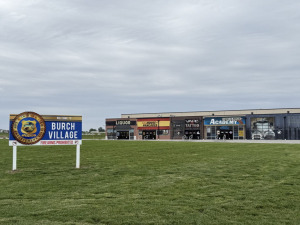
The academy also built a “scenario village” designed to simulate real-world calls. The mock streetscape includes storefronts and spaces resembling a liquor store, gun shop, tattoo parlor, vape shop, diner and even a small jail area where recruits can work through practical exercises in more “realistic” settings.
Rather than simply talking recruits through hypothetical situations in classrooms, instructors can now send trainees into mock homes and trailer-style structures where they respond to domestic disturbances and other scenarios.
“No longer do we have to take a student and say, ‘Pretend like you’re at a house where there’s a domestic,’” Horty said. “It’s an institute of higher learning, so we try to marry the classroom with the functional scenario portion of it. We want to put them in the classroom, make sure they pass the written test, and then let’s come out and do a practical test that makes sense for them.”
There was one “splurge,” though. Horty said a small memorial plaza built just outside the new classrooms recognizes officers who have died the line of duty and will serve as “our sort of sacred space” where the academy can host celebrations and receptions.
“It’s about reverence,” he said, “and just having a holy spot.”
Remaining work — and future possible upgrades
Most of the core renovation project is expected to wrap up by early September, Horty said.
The remaining work includes final renovations to the learning resource center — to be used as a board room and for executive meetings — as well as completion of expanded legal offices and upgrades to second-floor dormitories that will add another 80 beds primarily intended for Indiana State Police recruits.
Additional work is also underway outside the main capital project.
Lawmakers recently approved another roughly $1.7 million for repairs to the academy’s firing range after officials discovered bullets were ricocheting beyond the intended impact zone near the newer driving track.
Indiana State Police Superintendent Anthony Scott told the State Budget Committee in April that the problem only became apparent after construction of the new driving course.
“The new construction of the Emergency Vehicle Operations course was built in the ricochet zone for the existing range,” Scott said during the hearing.
The fix will include a steel-and-concrete baffling system designed to fully capture stray rounds and allow simultaneous use of the firing range and driving track.
Horty stressed Wednesday that the shooting range issue is separate from the broader campus renovation project.
“This is like your air conditioning unit breaks,” he said. “It’s something that has to be fixed immediately.”
Additional long-term improvements could still follow.
Academy leaders have discussed further upgrades to maintenance areas, technology systems and other aging portions of the campus as operational demands continue to grow.
“You have to keep up with the technology or, you know, you’re losing your students,” Horty said. “They need to be stimulated. They need to have the best technology available, because they use it every day.”
Beyond police training, the academy also serves as a state continuity-of-government site, prompting an additional $1.93 million funding approval in August for generators and other infrastructure. The upgrades are intended to ensure portions of Indiana government could continue operating from the campus during a catastrophic emergency affecting downtown Indianapolis.
“That’s why we need dormitories,” Horty said. “We have a cafeteria where we could feed (state employees). We have dormitories where they could stay, and we have meeting rooms and classrooms where the state of Indiana’s function can continue.”
The campus has also added expanded fencing, camera systems, bollards and other security features tied to that mission, Horty noted.
Managing costs amid broader state cuts
Even as construction spending ramped up, the academy was not immune from statewide belt-tightening.
Like other agencies, ILEA faced 5% budget reduction requirements during the last state budget cycle.
Internal budget documents reviewed by the Capital Chronicle show academy leaders froze multiple vacant positions, reduced textbook distribution, limited travel and cut equipment purchases in an effort to avoid layoffs.
The academy also leaned on Department of Correction inmate labor for landscaping and maintenance work while shifting purchases to an “as-needed basis,” according to the spending reduction plan.
“We found a way to make it without having to lay anybody off,” Horty said Wednesday.
Still, ILEA leaders acknowledged the academy’s expanded footprint — including more than 86,000 additional square feet already online — will create higher long-term operating costs for utilities, maintenance and supplies.
Horty said he understands why lawmakers have questioned the growing cost of the renovations.
“We’ve spent a lot of money, but I think we’ve made improvements that will last generations,” he said. “And I want the community to know that we did good things with this. We were judicious with the money — and I spent every dollar like it was my own in this facility.”
“The barometer is a better trained, more professional police officer as a result of this facility,” Horty continued. “I think we’re going to get what we invest in.”
Indiana Capital Chronicle is part of States Newsroom, a nonprofit news network supported by grants and a coalition of donors as a 501c(3) public charity. Indiana Capital Chronicle maintains editorial independence. Contact Editor Niki Kelly for questions: [email protected].
Please enable JavaScript to view this content.